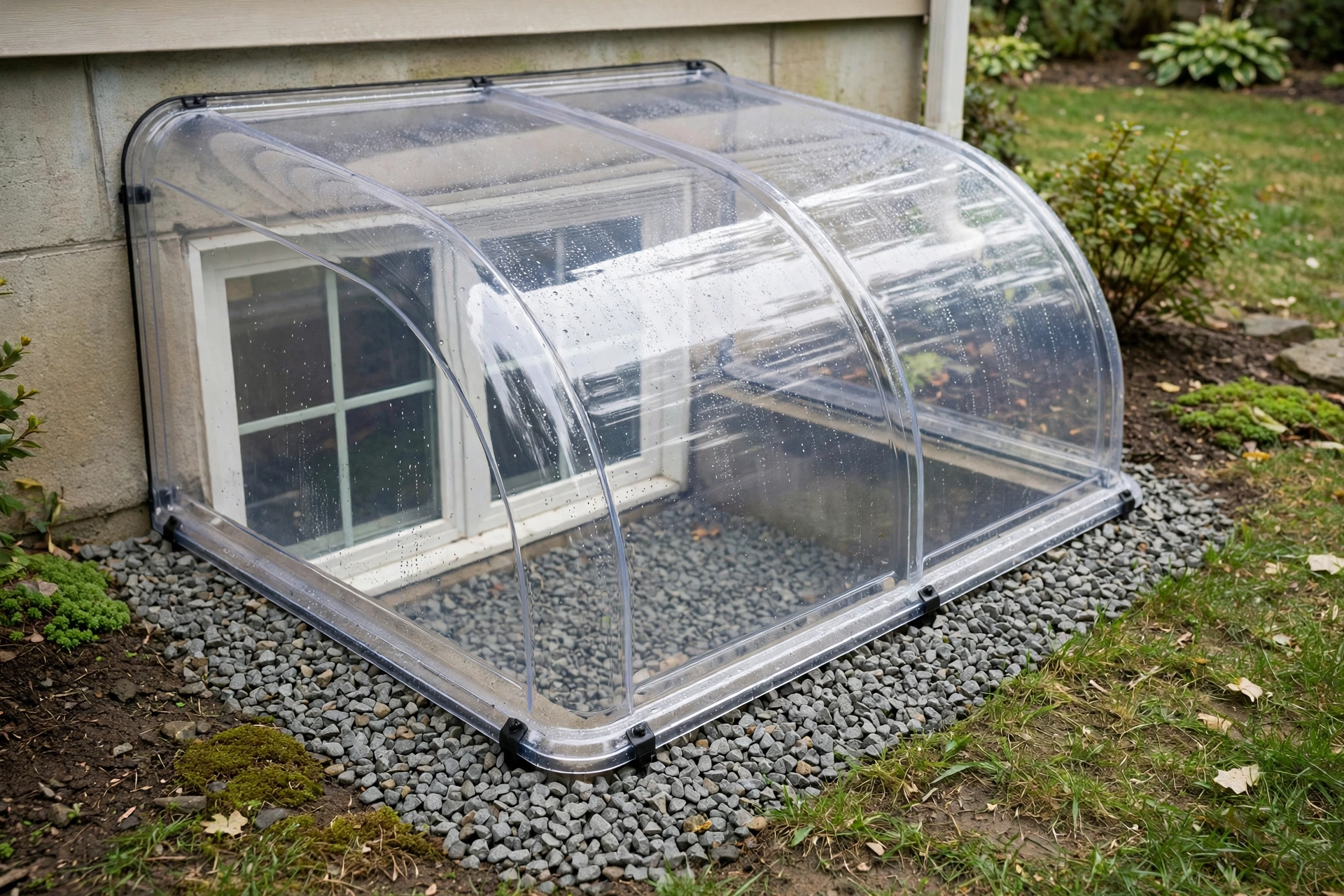
A basement window sits in a pocket of earth below ground level, and that pocket is remarkably good at collecting water. Rain runs off the roof, snow melts against the foundation, and surface runoff sheets across the yard until it finds the lowest point it can reach, which is often the window well. Left alone, the well fills like a bathtub pressed against a window that was never designed to hold back standing water. A window well drainage cover is the first line of defence in that fight, and this guide explains how to choose one, fit it, and back it up with the drainage that actually keeps a below-grade window dry.
The direct answer is that a good cover sheds rain and snowmelt away from the well, blocks leaves and debris from clogging the drain, and still lets daylight reach the basement window. It does not waterproof the well on its own, and anyone who tells you otherwise is selling you a lid for a problem that starts in the yard. Covers work best as one layer of a system that begins with grading and gutters, continues through gravel and a working drain, and ends with a cover that keeps the everyday weather out for good.
What a Window Well Drainage Cover Actually Does
Understanding that limit saves both money and disappointment. Homeowners who buy the most expensive cover first and skip the grading often find the well still floods in the first heavy storm, because the water was never falling from the sky into the well at all. It was running across the yard, under the cover’s edge, and down the foundation wall. A cover is the finishing layer of a dry window well, not the foundation of one, and it earns its price only when the water reaching it from above is the water it was built to shed.
How Surface Runoff Reaches a Below-Grade Window
Surface runoff reaches a window well by following the slope of the land, and most yards slope toward the house more than their owners realise. Soil settles against the foundation over the years, mulch beds level out, and a patio laid dead flat quietly directs every shower toward the wall. The ground beside a foundation should slope away from the house at roughly six inches over the first ten feet, which is enough to send rainwater sheeting across the yard instead of into the well. When that slope is missing or reversed, the well becomes the lowest point on the whole side of the house.
Roof water makes the problem much worse, because a single downspout can discharge hundreds of gallons against the foundation during one storm. Downspouts should release water at least six to ten feet from the wall, and buried extensions that carry roof water to the far side of the yard are the cleanest permanent fix. Walk the yard during the next heavy rain and watch where the water actually goes, because the path it takes will show you exactly which downspout and which stretch of grade is feeding the well.
Cover Materials Compared: Polycarbonate, Metal Grates, and Mesh
| Cover material | Keeps out rain | Lets light in | Best for |
|---|---|---|---|
| Clear polycarbonate | Yes, when sloped | Yes | Bedrooms and living areas below grade |
| Metal grate | Partly, sheds heavy flow | Yes, through the grid | Wells beside walkways and driveways |
| Fine mesh screen | No, rain passes through | Yes | Leaf and debris control only |
| Solid metal lid | Yes, fully sealed | No | Storage rooms and unused wells |
For a bedroom with an egress window, the material choice carries a safety rule that overrides everything else: the cover must lift off from inside the room without tools, so anyone escaping through the window is never trapped by the cover itself. Check that requirement before ordering, and test the release from inside once the cover is fitted. A cover that needs a key, a screwdriver, or a strong lift from outside is not just inconvenient on an egress window, it is unsafe.
Sizing and Fitting a Cover to an Odd-Shaped Well
Window wells come in more shapes than catalogues admit: half-round metal wells, square masonry wells, oversized egress wells, and old wells that have shifted a few inches out of square over the decades. Measure the well at its widest points, outside edge to outside edge, and then measure again at the narrowest, because a cover sized to the wide dimension will rock on a well that narrows at the back. Write down the shape, not just the numbers, and photograph the well from above so the supplier can see the curve or the corner that the tape measure cannot describe.
- Measure width, depth, and height at three points each, and use the largest measurement plus a small overlap.
- Check the well rim is level with a spirit level, because a cover cannot seal on a rim that tilts.
- Note any pipes, vents, or steps that pass through the well, since the cover must clear them or be cut around them.
- Choose a sloped or domed profile for wells that collect snow, so the cover sheds its load instead of holding it.
- Order one size up for egress wells, where the cover must clear the ladder or steps inside the well.
Fitting is usually a ten-minute job once the size is right: set the cover on the rim, check it sits flat without rocking, and fix the clips or brackets that hold it against wind. If the cover rocks, the rim is uneven, and a bead of exterior sealant or a thin shim under the low side will settle it. Never force a cover that is too small by bending it, because a stressed polycarbonate panel cracks at the first frost, and never leave an egress cover clipped down so tightly that it cannot be lifted from inside.
Grading and Gutters: Stopping Runoff Before It Reaches the Well
Grading is the cheapest and most effective window well repair there is, and it starts with a shovel rather than a catalogue. Add compactable topsoil against the foundation and shape it so the first ten feet fall away from the house, then check the slope with a level and a straight board. Keep mulch and planting beds below the level of the foundation’s damp-proof course, because a flower bed piled against the wall holds moisture against the brick and feeds the well every time it rains. Re-check the grade every spring, since soil settles and the slope you built last year may already be gone.
Gutters deserve the same attention, because a blocked gutter turns the roof into a waterfall aimed at the foundation. Clean gutters twice a year, in late autumn after the leaves fall and again in spring, and check that every downspout is connected and discharging well away from the house. A downspout that ends at the foundation wall can deliver more water into one window well in a single storm than a month of ordinary rain, so extending it even a few feet is often the single biggest improvement a wet well ever gets.
Gravel Beds and Passive Drainage Under the Cover
Even with a good cover and proper grading, some water will reach the well, and the gravel bed underneath is what disposes of it. The well should extend eight to twelve inches below the bottom of the window sill, creating a small reservoir, and the bottom should hold eight to twelve inches of clean, coarse gravel that lets water percolate into the subsoil. That gravel is a filter as much as a drain: it holds the well open, spreads the water over a wide area, and keeps soil from washing against the window frame.
- Use clean, coarse gravel such as pea gravel or crushed stone, never fine sand or soil that compacts into a plug.
- Keep the gravel free of leaves and silt by scooping the well out each autumn before the wet season starts.
- Top the gravel up when it sinks, because a bed that has settled below the sill no longer protects the window.
- Never pave over the gravel with concrete or slabs, which turns a drain into a sealed basin.
Passive drainage works only as fast as the soil beneath it can absorb water, and that is its honest limit. In sandy soil, a gravel bed can empty a well overnight after a storm. In heavy clay or where the water table sits high, the same bed can stay wet for days, and the water will rise against the window seal no matter how clean the gravel is. If your well holds water for more than a day after rain, the soil is telling you that passive drainage has reached its limit and an active drain is the next step.
When a Passive Well Needs an Active Drain
Installing an active drain means digging out the gravel, cutting into the perimeter drain or digging a dry well, and making sure the pipe falls continuously toward its outlet with no dips where water can sit. It is a bigger job than fitting a cover, and in many homes it is worth hiring a drainage contractor who can test the perimeter drain first, because connecting to a blocked or collapsed perimeter drain achieves nothing. Get the outlet right and the well stays dry in weather that used to flood it; get it wrong and you have simply buried the problem.
Keeping the Cover Clear Through Snow, Leaves, and Storm Season
A window well cover earns its keep in every season, but each season asks something different of it. In autumn, leaves pile against the cover and block the slope that sheds water, so brush them off before the first heavy rain. In winter, snow loads the cover and then melts into it, so a sloped profile matters more than a flat one, and the cover should be cleared after heavy snowfall rather than left to carry the weight. In spring, check the clips and seals after frost has worked on them, and in summer, check that the cover has not yellowed or warped in the sun.
| Season | Main risk to the well | Cover check |
|---|---|---|
| Autumn | Leaves blocking the slope and drain | Brush the cover clear weekly |
| Winter | Snow load and freeze-thaw cracking | Clear snow; check for cracks in spring |
| Spring | Heavy rain on saturated soil | Check clips, seals, and gravel level |
| Summer | UV yellowing and warping | Wash the cover; check it still sits flat |
The simplest maintenance routine is a two-minute look every month and a proper clean twice a year, and it is worth writing into the same calendar as gutter cleaning so it actually happens. Lift the cover, scoop out any debris, check the gravel is still clean and level, and confirm the cover still lifts freely from inside on egress windows. A cover that is maintained lasts for years; a cover that is fitted and forgotten slowly stops doing the job it was bought for.
Window Well Drainage Cover FAQs: Egress, Flooding, and Upkeep Questions
Will a window well cover stop my basement window from flooding?
Partly. A cover stops rain and snowmelt falling directly into the well, which is often the largest single source of water. It cannot stop water arriving from below through saturated soil or a failed perimeter drain, so if the well fills from underneath, the fix is grading, gutters, and an active drain first, with the cover as the finishing layer that keeps everyday weather out.
Can I put a cover on a bedroom egress window?
Yes, but the cover must lift off from inside the bedroom without tools, so anyone escaping through the window is never trapped. Choose a lightweight polycarbonate cover with a simple lift-off or push-out release, test it from inside after fitting, and never screw or lock an egress cover down. Check your local code, because egress rules are strict and vary by area.
What size window well cover do I need?
Measure the well outside edge to outside edge at its widest points, then add a small overlap so the cover sheds water past the rim rather than into the joint. Measure at three points, because old wells are rarely square, and photograph the shape for the supplier. For egress wells, order one size up so the cover clears the ladder or steps inside.
How do I keep the gravel drain under the cover working?
Scoop leaves and silt out of the well each autumn, top up the gravel when it sinks, and never let soil or mulch wash into the bed. Use clean, coarse gravel eight to twelve inches deep, and if the well still holds water for more than a day after rain, the soil beneath is too slow to absorb it and an active drain pipe is the next step.
Is a clear or a solid window well cover better?
Clear polycarbonate is better where the window provides daylight to a bedroom or living space, because it keeps water out without darkening the room. A solid metal cover is stronger and better where the well sits beside a walkway and must carry foot traffic, or where the window serves only a storage room. For most homes, a sloped clear polycarbonate cover is the best balance.
Final Thoughts: A Dry Window Well Starts Above the Ground, Not Inside It
A window well drainage cover is a small purchase that does a real job, but only when it sits at the end of a system that starts in the yard. Grade the soil away from the house, extend the downspouts, keep the gravel clean, and then fit a sloped, well-sized cover that sheds the rain the other measures cannot reach. Do those things in that order and the well stays dry, the window stays clear, and the basement stays the dry, usable room it was meant to be. Skip the groundwork and buy only the lid, and the next heavy storm will show you exactly where the water was coming from all along.